Showing posts with label Online Opinion. Show all posts

Saturday, June 28, 2008

UPDATE: Stuff published elsewhere ...


Apart from the op-ed published in the Canberra Times on 28 July 2008, there was some comment about the whole issue (or rather, non-issue) of polygamy in The Age here.


When it comes to racism, some conservatives just don't get it. You can about an incident in the United Kingdom related to this theme published in that wonderful website New Matilda here.


And what is it about human beings and pigeon holes? Check out the comments attached to the version of this article republished by the wonderful folk at Online Opinion here.

UPDATE I: Keysar Trad provides this response in a letter to The Age ...

IRFAN Yusuf's article "Just how many people are behind the polygamy push?" (Comment & Debate, 27/6) is plainly wrong on many counts. It would have
taken a simple phone call to prove that Islamic Friendship Association members
are not all "Trads".

Unfortunately, I have become used to the defeatist response that if you cannot counter the argument, you attack the person presenting it. This shooting of the messenger does nothing to address real social issues, which in this case are not just Muslim issues, but issues of perhaps a third of society engaging in plural relationships.

Who is behind the "the polygamy push"? There is no push. There is an opinion, which I expressed, that my faith can offer a solution to people who find themselves in plural relationships. I have repeatedly stated that we have no interest in making any representations to the Federal Government to decriminalise the actions of people who take the responsibility for such relations.

Keysar Trad, Islamic Friendship Association of
Australia


Who is this "we", Keysar? And where is the evidence that a third of Australian society engages in what you describe as "plural relationships"? And in what sense is it a personal attack to argue that your views are not representative of mainstream Muslim opinion in Australia? Or that your association has no right to present itself as speaking in any representative capacity?

And how long must we wait before we see the Islamic Friendship Association having a spokesperson other than Keysar Trad? I won't be holding my breath ...

UPDATE II: Someone from an internet forum posted this response ...

"Keysar Trad, president of the Islamic Friendship Association (whose members, I suspect, share the same surname and hold dinner meetings each night in the same home)"
well skewered


Words © 2007 Irfan Yusuf


Delicious
Bookmark this on Delicious
Digg! Get Flocked

Monday, March 27, 2006

OPINION: Afghan Courts Make a Mockery of Sharia

Guess what! Some Muslims are in the news again. And as always, they are doing exactly the opposite of what their faith and values intended.

And if you thought a minority of hysterical Muslims were slow (6 months) in responding to the Danish cartoons, try this for size. The Afghan authorities and judiciary took a whole 16 years to work out one of their own had changed religions.

The good news is that the Muslim government involved is, at least for now, from the good side. And thankfully, they seem to be doing something to stop the clear abuse of sharia law.

Freedom & democracy from Guantanamo to Kabul

Hardly a few weeks after the Danish cartoon saga, the pro-American government of Hamid Karzai has been caught out trying to revive the old Taliban legacy. And boy, don’t the war-on-terror brigade have egg on their faces.

Even poor Australian Prime Minister John Howard has admitted he isn’t very happy with the decision by the Afghan judiciary, whose judges are handpicked by Mr Karzai and his Ministers, to place a man on trial for the nasty deadly crime of … wait for it … converting to Christianity!

Australia’s troop presence in Afghanistan has recently been beefed up. Young Australian men and women are risking their lives to ensure that a pro-democracy and pro-freedom government can remain in power for long enough to potentially send a Christian to the gallows. Or was that the firing squad? Who knows?

Mr Howard says that when he first read about the Afghan Christian’s plight, he “felt sick – literally”.

But then, the Aussie PM shouldn’t complain. Poor Abdul Rahman has at least been told what he is charged with. Unlike so many of the Afghan and other Guantanamo Bay inmates who have been in custody for over 4 years now without charge.

Australia has one remaining Guantanamo prisoner. David Hicks faces what his US Military lawyer appropriately describes as a “kangaroo court”. Yet the Australian government refuses to lift a finger to assist one of their own citizens. With British PM Tony Blair visiting Australia, perhaps Mr Howard could learn some lessons from Mr Blair about how a country following the Westminster tradition of Parliamentary democracy should stand up for its citizens.

Misusing sharia to deny custody to a father

Still, this article is not about David Hicks or Guantanamo. Nor is it about the Abu Ghraib prisoners. This is about the Afghan government which practises the same excesses to those who claim that dropping depleted uranium on entire towns and cities is the best way to spread freedom and democracy.

And worse still, it is about people imposing barbaric punishments in the name of enforcing Islamic law.
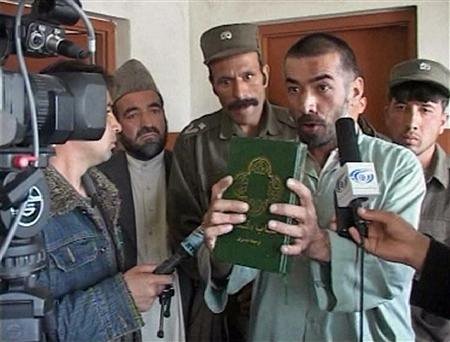
Now before we start with the legal analysis, let’s try and master the facts. With all the hysteria of much western reporting, it is hard to know exactly what poor Abdul Rahman’s background is.
Abdul Rahman is a 41 year old Afghan father who has lived overseas for some 15 years. He returns to Afghanistan for a custody battle with his wife who lives in Afghanistan. A relative with a personal vendetta claims the father has converted to Christianity and dobs him into the authorities.

It’s amazing what people are prepared to do to pursue personal vendettas. Even if it is true that the father had converted to Christianity, what does this have to do with the price of Persian rugs in the Kabul bazaar?

The children have apparently lived in an Afghan Muslim environment all their lives. How they survived Russian intervention followed by civil war followed by Taliban rule followed US-led bombings followed the present chaos is anyone’s guess.

What are the merits of Rahman’s custody battle? Who knows. Certainly under the family law of most Western countries, he would have little chance of gaining custody. Under Australia’s Family Law Act, a court would be most reluctant to change the status quo of the children’s living arrangements without good reason.

And under Australia’s mandatory detention laws, the fact that the children are escaping a regime which kills them for belonging to the wrong tribe and/or sect isn’t enough to stop them from being thrown into a detention centre in the middle of the desert. At least that was the case until recently.

Indeed, one Kashmiri convert to Christianity was kept in Australian detention longer than any Muslim detainee and suffered severe trauma as a result. Peter Qasim’s conversion and fears for his safety didn’t stop the Howard government from keeping this hapless fellow behind bars.

To hudood or not to hudood

Even more hypocritical and scandalous than the Australian government’s alleged commitment to freedom for Christian converts is the Afghan judiciary’s commitment to sharia.

According to trial judge Ansarullah Mawlafizada:


The Prophet Muhammad has said several times that those who convert from Islam should be killed if they refuse to come back.
It seems the learned judge has not read the verse of the Qur’an immediately following the Ayat al-Kursi (“Verse of the Throne”). In verse 256 of Surah al-Baqarah, the One who created Sayyidina Muhammad and honoured him with the Seal of Prophethood declares:

Let there be no compulsion in religion.

There isn’t a huge amount of consensus among classical and modern sharia scholars on what acts constitute apostasy or what its punishment should be. Indeed, even scholars who agree that an apostate should be put to death place stringent conditions on this punishment.

According to Shaykh Nuh Keller’s translation of Ahmad ibn Naqib al-Masri’s classic work of Shafi law entitled Umdat as-Salik (“Reliance of the Traveller”), a condition for implementing the death penalty is that the caliph or his representative must ask the apostate to repent and return to Islam (see para o8.7 of the Revised Edition).

Further, only the caliph or his representative can carry out the punishment. Unless I am mistaken, I do not believe Hamid Karzai is regarded as the Caliph of Afghanistan. Chapter III of the Afghan Constitution sets out the powers and duties of the President, described there as the Head of State. Chapter IV sets out provisions relating to the Government. Nowhere do the words “caliph” or “caliphate” appear.

Further, Abdul Rahman is said to have converted to Christianity whilst living in the United States. Whether this gives the Afghan courts jurisdiction over his “offence” is unclear.

Various scholarly views of apostasy

Indonesia is the world’s largest Muslim-majority country. Its largest Islamic organisation (which is also the world’s largest) is the Nahdlatul Ulama (Council of Scholars). One of the most senior sharia scholars and lawyers in the NU is Professor Mohammad Fajrul Falaakh.

Professor Falaakh is Vice Dean for Academic Affairs at the prestigious Gadjah Mada University Law School in Yogyakarta where he teaches both undergraduate and graduate studies in government and public law. He is also a member of the National Law Commission of the Republic of Indonesia (2000-03), and Deputy Chairman of the Central Executive Board of NU. Apart from extensive studies in Indonesia and the UK, Professor Falaakh has also worked within the traditional pesentran system of religious training.

In 2002, Professor Falaakh visited Australia and New Zealand at the invitation of the Centre for Independent Studies. On 11 December 2002, he delivered the Acton lecture on Religion & Liberty at the Great Hall of the Parliament of New Zealand.

(An edited version of the text of Professor Falaakh’s talk can be found by accessing the website of the Centre for Independent Studies, going to the search feature and typing in the word “Islam”. Professor Falaakh’s speech is the first item in the list.)

In his speech, Falaakh lists the five basic principles of sharia. The first item in this list is “the protection of religious freedom, or the protection of religion and the way religion is observed”. Falaakh says that this freedom must be preserved even where sharia is “interpreted … more strictly”.

The third item in the list is "hifzh al-aql, meaning mine-that is, freedom of thought, freedom of conscience.” Here, Falaakh addresses the issue of apostasy directly, especially as applied in a pluralistic society. He continues …


What if, according to my own understanding, I exercise my freedom of thought and choose another religion, denouncing the one that I had professed before and embracing the new one? What about the regulation or provision that many Muslims believe in that those who renounce Islam will be punished by death?

… The traditional, conventional understanding of apostasy in Islam says that once you enter into Islam there is no way that you can leave, otherwise you will put yourself to death. If that is really the case, why does the sharia claim early on that there is to be protection of religion?

… There was a time when some parts of the Muslim community back in the 7th century were reported to have had renounced Islam and they were chased and punished by death … at the same time, they also waged war, turning against the community they had previously belonged to. So was that a very obvious case of apostasy or a case of rebelling against a political entity that you used to agree with-in other words, violating a political pact you created together with other people? So perhaps it was not really religious at all. It was simply a political affair.
Falaakh is not alone in the view that the original capital punishment for sharia was more related to the crime of treason. Professor Abdullah Saeed of the University of Melbourne, a graduate of the International Islamic University of Madeenah Munawwarra, recently co-authored a book on the subject together with Hassan Saeed, Attorney General for the Maldives.

Entitled Freedom of Religion, Apostasy & Islam, the authors argue that the early development of the law of apostasy was largely a religio-political tool. Further, there is a diversity of opinion among early Muslims on the punishment. There are substantial ambiguities about what constitutes apostasy, and the textual evidence doesn’t always assist in resolving these.

The authors conclude that those arguing in favour of the death penalty neglect a vast amount of clear texts in the Qur’an which favour freedom of religion in constructing the law of apostasy.

Indeed, even if the criminal law of sharia regards apostasy as a serious enough act to warrant being classed as hudood (subject to capital punishment), can such punishment be implemented in an environment where government, judiciary and police are corrupt? Is the case of Abdul Rahman not one in which Professor Tariq Ramadan’s call for a moratorium on hudood punishments should apply?

Conclusion

Given the stated commitment of Afghanistan Constitution to international law as enshrined in the Principles of the UN Charter and the Universal Declaration of Human Rights, perhaps the most appropriate Muslim response to the arrest and trial of Abdul Rahman is that of a spokesman for the Australian Federation of Islamic Councils.

When asked about Abdul Rahman, AFIC spokesman and lawyer Haset Sali responded:


Such barbaric action by anyone seeking to quote Islam as supporting their criminal action needs to be dealt with as a crime against humanity.
One hopes other Muslim leaders take a similar position to what is clearly a travesty of sharia and of justice. If Muslim minorities do not stand up for the rights of non-Muslims in Muslim-majority states, their occasional claims to being oppressed minorities themselves will not be taken seriously.

Or as the Prophet Muhammad (peace & blessings of God be upon him) said:


The one who oppresses the non-Muslim citizen will have me testifying against him on the Day of Judgment.


(This article first appeared on the AltMuslim website.)

Sunday, February 05, 2006

OPINION: Get your own house in order before you go tearing others' houses down ...

Around 900 years ago, back in the days when most of Europe was lost in the Dark Ages, the then-deranged Muslim ruler of Jerusalem decided to tear down the Church of the Holy Sepulchre. He was quickly deposed, and the Church hastily rebuilt at Muslim expense. The Muslims apologised.

It was too late. Within a few months, reports of similar attacks on Christian pilgrims and symbols in Palestine had spread across Europe. Pope Urban II seemed powerless to respond. He was more concerned with corruption within the Vatican (much of it his own doing), and with the presence of other allegedly false competing claimants to the Pontiff’s throne.

The Pope's “solution” to the internal crisis was to seek a diversion. He declared the first Crusade. Historians agree that in leading this battle, the then-Pontiff was less interested in defending the honour of Christ or Jerusalem than in shoring up his own power and diverting attention away from crises within the Church.

Hardly 900 years later, the tables have turned. This time it is mainly Muslim leaders who are embroiled in corruption and scandal. The generals, emirs, kings and presidents-for-life that rule most Muslim-majority states (usually with the help of their Western patrons) have failed to effectively deal with the poverty, illiteracy and other economic and social ills too numerous to list here.

Today these rulers are also seeking a diversion. One obscure neo-Conservative Danish newspaper appears to have provided it. What they have also proven is that perhaps Muslims are in the midst of their own Dark Age.

In the past few weeks, two bastions of Middle Eastern liberty and democracy - Libya and Saudi Arabia - have withdrawn ambassadors from Denmark. In many Muslim countries, Danish goods are being boycotted.

In my birthplace of Karachi, frenzied Pakistanis hit the streets with protests that did more damage to the Pakistani economy than to anyone in Denmark. Don’t these people have work to do and mouths to feed? Then again, some of these men (Pakistani women have more important matters to attend to) will protest each time they think a Pakistani batsman is given out lbw unfairly.

And across the Arab world, supermarkets have removed Danish goods from their shelves. Recently, a Syrian Muslim rabble decided that the best way to defend the honour of their Prophet was to attack and burn embassies of at least three European countries. In Gaza, with Israel ready to cut the fiscal umbilical cord, Palestinian gunmen seem content to bite one of the few hands that feeds them by occupying and threatening workers at the headquarters of the European Union.

Had someone unaware of the cartoons viewed the response, they might think Denmark has invaded Bosnia or Iran and was unjustly occupying its territory. They might think Danish settlements replaced Israeli ones popping up in various places across the West Bank. Or perhaps the Danish government had passed laws banning girls from wearing headscarves in schools.

Of course, nothing of the sort happened. Instead, an obscure privately-owned newspaper in Denmark published cartoons depicting the Prophet Muhammad. One cartoon apparently showed the Prophet standing at the pearly gates of heaven in much the same way as St Peter in the Catholic tradition. Another portrayed the Prophet’s turban as a bomb.

The cartoons were first published in the Morgenavisen Jyllands-Posten. Most people living in Muslim countries would probably be unable to pronounce the paper’s name, let alone having heard of it.

And so today, I and many other Muslims feel compelled to stand up and be counted. To defend the honour of a man I grew up to regard as a Prophet.

No, not from a dozen cartoons published by a neo-Conservative Danish newspaper. Nor from their reproduction in newspapers across Europe and even New Zealand.

We feel compelled to defend the honour of the Prophet of Islam from the shameful actions of some people claiming to be his followers.

No, we are not ashamed of Islam. We are not ashamed of the Prophet Muhammad. We are not ashamed of the values many of us grew up with, values that are so similar to those of my Anglican school or my many Jewish colleagues and friends.

What upsets and shames us is the depths to which some Muslims have sunk.

I wonder at how low Muslims have stooped that some of them are prepared to resort to mob violence to display their religiosity. In doing so, they appear ignorant of (or worse still, reckless to) the fact that they are mainly targeting the innocent.

The Arabic phrase used by the Qur’an to describe the Prophet Muhammad is “rahmat al-lil a’alameen” (literally “mercy to the worlds”). Like the other Prophets recognised by Islam (including the Messiah Jesus), Muhammad always preferred forgiveness over revenge.

Instead of following his example, many 21st century Muslims are behaving in similar vein to the then uncivilised medieval Europeans did during the Crusades.

Today, some Muslim mobs are attacking anything deemed Danish. They are being egged on by selfish, undemocratic and dictatorial kings, generals, emirs and presidents-for-life.

Muslim countries are suffering problems taller than the tsunami waves that brought so much misery to hundreds of thousands of Muslims in Indonesia.

Muslim women in various countries are being murdered by members of their own families for the sake of defending some false notion of “honour”.

Millions of Muslims are living in poverty and disease in Pakistan following the devastating earthquake. Millions more are starving in refugee camps in Nigeria and other parts of Africa.

Muslim-majority nations are riddled with corruption. Their leaders are squandering resources and wealth whilst their citizens live below the poverty line.

Yet today some governments of Muslim-majority countries are encouraging their citizens to attack European embassies. For many dictatorial and undemocratic Muslim regimes, the cartoon controversy represents a wonderful diversion away from the real problems facing their communities.

Instead of protecting the honour of their Prophet, some Muslims seem intent on destroying their own honour by behaving in a manner their Prophet had condemned 14 centuries ago.

What appears to have (quite understandably) upset Muslims most is one cartoon depicting the Prophet wearing a bomb as a turban, suggesting that he preached terrorism. Yet surely the worst way to protest against this is to commit acts of terror such as tearing down and burning embassies.

Boycotting Danish goods may be a more peaceful and preferable manner of protest. Yet even such a boycott effectively punishes the innocent and attributes the disrespectful manner of one newspaper to an entire nation. To blame all Danes for the actions of one newspaper editor claiming to defend freedom of speech is as absurd as blaming all Muslims for the acts of terror of a few lunatics claiming to defend of Islam.

Those Muslims who really care about the honour of their Prophet should focus their attention on improving their own situation. They might start by considering what sort of deal non-Muslim minorities get in Muslim countries, and how non-Muslim religious symbols are abused in Muslim publications. Perhaps they would then understand why some Muslim minorities leaving peacefully in Western countries (including Denmark, New Zealand and Australia) may cop plenty of flack due to their antics.

The Muslim mobs might also consider how the Prophet responded to attacks on himself. I am not aware of any biographical record of the Prophet taking any revenge for attacks on his person. I remember one recorded incident of a Jewish neighbour who was in the habit of pouring faeces over the Prophet. One day, the faeces stopped. The Prophet’s response was to inquire about the neighbour’s health.

How far some of today’s Muslims are from the golden example of the man in whose name they are causing so much destruction. Don’t they have enough problems of their own to be concerned with? In the grander scheme of things, in the context of poverty and natural disasters and culturally-related oppression of women.and so much else, are some Muslims so narrow-minded and infantile as to ascribe so much importance to 12 cartoons?

My message to Muslim mobs is simply this - before you consider tearing down the houses (and embassies) of others, think about cleaning up your own.

(The author is a Sydney-based industrial and commercial lawyer and a freelance columnist whose articles have been published in the Sydney Morning Herald, Australian Financial Review, Daily Telegraph, Courier-Mail, Canberra Times and New Zealand Herald. He is a columnist for Online Opinion and altmuslim.com and regularly controbutes to the Web Diary. This article has also been published at Online Opinion on 6 February 2006 and in the Dominion Post (published in Wellington, NZ) on 8 February 2006.)

Words © 2006 Irfan Yusuf

Delicious
Bookmark this on Delicious

Digg!

Get Flocked

Tuesday, October 18, 2005

OPINION: Just Shoot Me?

I’m an Australian. I grew up in the heart of the Prime Minister’s electorate. I attended an Anglican school. I practice law and do some freelance writing. I speak with a broad Australian accent. English is my first language. The only passport I ever held was an Australian one. My favourite item of clothing is my Wallabies jersey.

I also happen to have a Muslim background. I have a Turkish and Arabic name. And after reading the provisions of the draft Anti-Terrorism Bill 2005, I am terrified.

It took over 100 years to develop industrial relations into its current form in Australia. Now, the Commonwealth is spending millions educating us about our Work Choices. Most ALP premiers are up in arms at the loss of State jurisdictions in sensitive areas such as unfair dismissal.

Industrial reform interests me because it is the area in which I practice the most. The rights and freedoms of Australian employers and employees is an important issue. We need to have public debate on workplace reform.

Our civil liberties date back to ancient Greece. It took centuries of civilisation and philosophical effort to develop our liberal democracy. It took hundreds of wars costing millions of lives to protect liberties we all take for granted.

But for some reason, the Prime Minister and most State and Territory leaders are resisting debate on laws which represent perhaps the biggest assault of basic Australian civil liberties since Federation.

To make matters worse, few governments were happy to have the draft laws released to those whose liberties will be most affected – ordinary Australians. Were it not for the brave actions of ACT Chief Minister Jon Stanhope, Australians would have had no hope of having some idea of the extent to which liberties were endangered.

Mr Howard says the laws are based on agreement reached between Commonwealth, State and Territory leaders. He says there is little point having a discussion.

Effectively he is expecting Australians to accept the idea that police should have power to kill anyone they suspect of being a terrorist. The “shoot to kill” power was nowhere mentioned in the PM’s proposals released on 8 September 2005. Nor was there any mention at the Council of Australian Governments meeting on 27 September 2005 of police being allowed to kill terror suspects.

So who will be shot? What sort of persons could be killed as potential terrorists?

Under United States law, there is a list of organisations deemed to be terrorist organisations. Membership of and support for such organisations is an offence. The organisations include the usual suspects such as the Abu Nidal Organisation. They also include the Israeli Kahane Chai movement, certain Northern Ireland militias and the Tamil Tigers.

In Australia, only groups linked to Islam or Muslims are deemed terrorist groups. Already, the president of a national union representing police officers across the country has stated that the proposed laws can only be implemented using ethno-religious and racial profiling.

Now let’s be honest with ourselves. If a terrorist act occurred in Sydney or Melbourne, which ethno-religious group would be the first suspected of involvement? Vietnamese Buddhists? South African Jews? Kiwi back packers?

Would police officers be scouting yoga classes at Byron Bay for terror suspects? Will shock jocks be calling upon the governments to crack down on Steiner Schools? Will Liberal backbenchers be complaining about Hindus not abiding by Australian values? Will there be talk of detaining Callithumpians in special camps for their own protection?

The reality is that people with strange names and/or slightly darker skin colour will be the first suspected. That means men with beards and women with veils. And that means many Muslim Australians will be targeted. But not just them.

Some months back, I employed a clerk to work in my law firm. She has an Anglo-Australian father and a South Indian mother. She considers herself a Catholic and was born in Australia. Yet following the London bombing, she could feel people were watching her more closely on trains and buses.

I have another friend who never met her Muslim father. I met her some 18 months ago when she was working behind a bar serving beer and wine. She has a typical Arabic name.

Within days of the September 11 attacks in New York, FBI agents arrested their first suspect. He had dark brown skin and wore a turban. Some days later, another man sporting a beard and turban was shot dead by a crazed killer seeking revenge. Both men were Sikhs.

Mr Ruddock insists that racial profiling will not be used in the implementation and enforcement of the new laws. But Mr Ruddock has not addressed the compelling argument made by the president of the national police union. State and Federal police will be implementing the laws on the ground.

If a terror suspect decides to run, police officers don’t have time to go before a magistrate or wait for specific orders. They just shoot. Just as they did in London. And when they realise the person they just killed was an Indigenous Australian or a French Jew or a Brazilian backpacker, it will be too late.